2 Camden Academy Latina Students Present Research at Coriell Science Fair
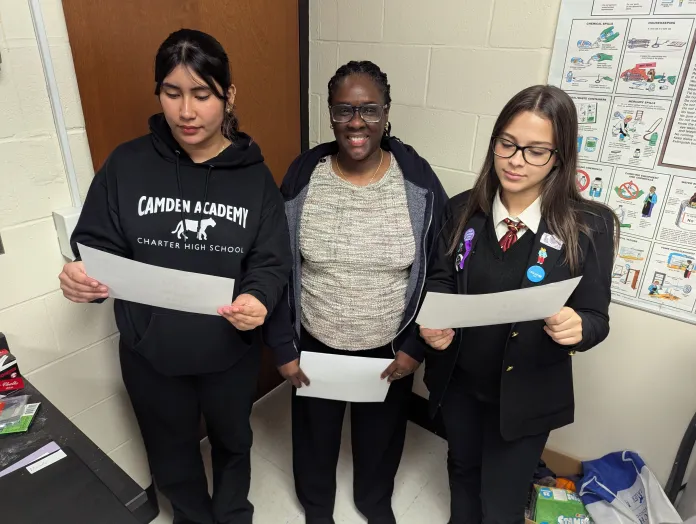
Manuela Gonzalez, Dr. Madeline Fenner, and Roselyn Rodriguez (left to right), get prepared for the Coriell Science Fair at Rutgers University Camden. Photo by Dean Johnson, Camden's Charter School Network
EDITOR’S NOTE: This story first appeared in Follow South Jersey. Dean Johnson works for Camden’s Charter Schools Network.
BY DEAN JOHNSON | Camden’s Charter School Network
CAMDEN – For the past 19 years, Camden Academy Charter High School students have presented their research and studies at the Coriell Institute Science Fair which was held on March 14 at Rutgers University-Camden.
The high school, which is part of Camden’s Charter School Network, has two students participating this year.
Manuela Gonzalez, senior, said that it was her friends that initially got her interested in the science fair.

“I was interested, because last year when I was a junior, I had a friend who were seniors who were doing the science fair, and it kind of just influenced me to do it, too,” Gonzalez said.
Gonzalez studied the effect of pH levels on decomposition in water sources around Camden City and its effect on decomposition.
“I want to major in biology, specifically in ecology and conservation,” she said. “This just seems to be part of that.”
Gonzalez ran two rounds of weekly testing in the Delaware, Cooper, and Schuylkill Rivers.
“A water source with more neutral pH would cause a constant rate of decomposition,” Gonzalez explained. “The Cooper River had the highest pH, and it ended up becoming more neutral as decomposition occurred, and then, for the water sample the second time, it was Delaware that had the most decomposition, and the more neutral pH.
Gonzalez said that studies like these are important for our eco-system.
“Decomposition is a really big factor in nature, and it’s one of the world’s own recycling processes, and it’s really important, because if you don’t have that in the ecosystem, ecosystems can get full of pollution,” she said.
Gonzalez added that participating in the science fair taught her about local ecology but there is also a practical reason.
“I think it would help me get a view of what I would be studying in the future,” she said. “it’s good practice, and it looks good on my transcripts.”
Roselyn Rodriguez, junior, ran a study on social media’s effect on students’ mental health and grades.
“I’m interested in psychology,” Rodriguez said, “and I’ve seen that social media is something that impacts teenagers a lot, so I wanted to really test it to see if all that was truly affecting their work and mental health.”
Rodriguez’s hypothesis was that students who spend more hours per day on social media will have lower grades and report higher symptoms of anxiety and depression.
For her study, Rodriguez distributed forms over several months to students who volunteered to be part of the study about the amount of social media use, screen time, anxiety levels, and grades.
She also added weekly open-ended questions for the volunteers to talk about their mental health that week, their grades, which apps did they use that week, and other personality questions.
“I found out that girls use social media way more than guys,” Rodriguez said. “Some weeks their grades were more down when their social media was higher, and overall the people with the higher social media screen time had the worst mental health,
Rodriguez said that while she didn’t expect any of the students to stop using social media, there was one student who took a week off from it.
“He was the one person that said his mental health was excellent,” she said.
While active in other extracurricular activities at the school, Rodgriguez said that participating in the science fair is different.
“I’ve never done anything like this before,” she said. “Participating in this fair is important because it puts me out there. I’m also looking forward to meeting people and seeing other people’s projects.”
Dr. Madeline Fenner, CACHS chemistry teacher and Coriell Science Fair advisor since 2007, said the students get to decide the topic of their study.
“They can do any kind of study,” Fenner said. “We had a student once make a robotic hand. We also had a student do a calculus project. We had a student a couple of years ago who made a flashlight that was AI centered, that was cool.”
The annual science fair, sponsored by the Coriell Institute for Medical Research in Camden, is for students in grades 6 through 12 from Camden, Burlington, and Gloucester counties. Last year’s fair had more than 100 middle and high school students participate from across South Jersey.
Science fair winners advance to the Delaware Valley Regional Science Fair, and winners from there can advance to the Regeneron International Science and Engineering Fair.
“We’ve gone to the regional,” Fenner said. “We’ve had students win in their category during the regional, but not overall.”
Fenner, who holds a doctorate in analytical chemistry and serves as science department chair at the school, said that participating in the science fair sends a greater message.
“I think it’s important because it shows students that everybody can do science,” Fenner said.
Note from AC JosepH Media: If you like this story and others posted on Front Runner New Jersey.com, lend us a hand so we can keep producing articles like these for New Jersey and the world to see. Click on SUPPORT FRNJ and make a contribution that will go directly in making more stories like this available. You can reach Editor Clyde Hughes at chughes@acjosephmedia.com. Thank you for reading!
About Author