Juneteenth: How Preserving Black Haddonfield History Project Is Changing Town’s Perception of Its Past
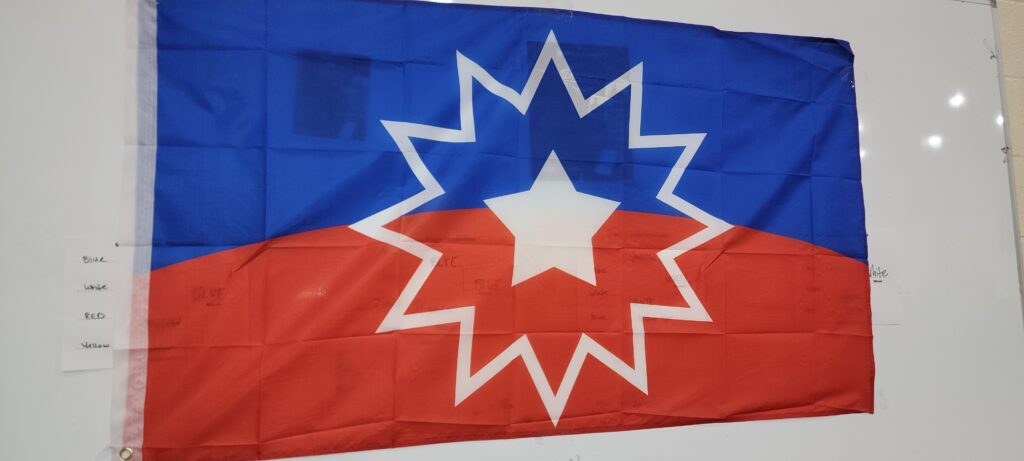
The Juneteenth flag is seen at the HELP Inc. Juneteenth celebration at Kingsway Middle School at Woolwich Township on Saturday, June 14, 2025. Photo by Meredith Winner/Mer-Made Photography.
EDITOR’S NOTE: This story was produced as part of the South Jersey Emerging Journalists Project (SJEJP), an independent initiative dedicated to supporting content creators and emerging journalists from underserved communities across Burlington, Camden, Gloucester, Salem, Cumberland, and Atlantic counties.
BY MILAN PARKER | South Jersey Emerging Journalists Project
HADDONFIELD — Haddonfield prides itself on 2.842 square miles of quirkiness.
Downtown, the local Hadrosaurus statue, a nod to the town’s claim as the birthplace of American paleontology, occasionally wears a tricorn hat.
The statue serves as a fitting mascot for a community that takes its history with a grain of fun, where every corner feels polished for public view, and national politics — at least aesthetically, take a backseat.

Getting lost in its charm is easy, but beyond the mascot and the brick buildings, Haddonfield is making room for the history it has long left out, an effort that requires more courage than celebrating a 65-million-year-old dinosaur that asks nothing of the present.
“I would describe the town as being in transition in terms of being more open,” said Joe Murphy, a local volunteer and recipient of the Preserving Black Haddonfield History Project’s first-ever DEI Community Leadership Award.
While Murphy isn’t a historian by trade, he is the kind of man who reads the town’s evolution the way others read a long story, looking for the parts that got cut before print. In Haddonfield, he found one.
For decades, a significant portion of the town’s history was contained to an area known as The Point: the streets where Haddonfield’s African American community lived, ran beauty parlors and barbershops, raised families, and produced educators, athletes, diplomats, and government officials who went out into the world and never made it back into the town’s official memory. Same public schools. Same sidewalks. A different story.
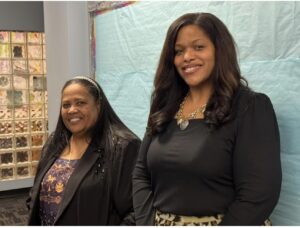
C. Adrienne Rhodes, founding president of the Preserving Black Haddonfield History Project, knows Haddonfield’s story from the inside. A fifth-generation native, her family has been here since the 1840s, descendants of enslaved people from the Eastern Shore of Maryland who settled in what is now Lawnside. She left, built a career that ran from the Lou Rawls Parade of Stars to the New York Daily News, and came back to find that the history she had grown up knowing was nowhere in the public record.
“People who had been entrusted to provide this kind of information were not providing it,” she said. “If they had, there would be no reason for the Preserving Black Haddonfield History Project to exist.”
So, she built it. Over three years, she and a small team of volunteers, most of them from the legacy families themselves, gathered more than 30 oral histories, published three volumes of anthologies, and built a walking tour of the borough’s historic African American sites. The work is deliberately specific.
It focuses not on Harriet Tubman or distant history, but on the woman at Mount Olivet Baptist Church whose uncle was its former pastor, the man whose grandmother was the first tenured African-American teacher in Haddonfield who also taught at the town’s segregated schools, and the woman who sat in at the Greensboro lunch counter and later became a college administrator: people you could pass on the street and never know.
Rhodes believes that once you know someone’s story, indifference is harder to sustain.
“When you humanize someone that way,” Rhodes says, “it makes it difficult to treat them as if they don’t exist.”
Murphy came to the project the way most things happen in a town this size, through a mutual friend, after a walking tour and a Sunday service at Mount Olivet Church that he wandered into and decided not to leave. He helped Rhodes secure a matching grant through the Haddonfield Foundation to fund the tour and install historical markers across town. He covered the legal fees to incorporate the organization.
When the state’s Black Heritage Trail program opened with a deadline only weeks out, he put up money to hire a doctoral candidate to complete the required bibliography. Haddonfield became the first site in Camden County to make the cut.
“My role,” he said, “is buying popcorn and helping C. Adrienne.”
At this year’s “What Would Martin Say?,” a public screening examining Dr. King’s teachings against the present moment in honor of Juneteenth, Murphy received the project’s first DEI Community Leadership Award. He accepted it in a way that embodies a personal philosophy, already thinking about what it might open up for someone else.
“I hope other people see this and think: maybe there’s something I could do,” he says. “In this town, if you’re willing to pick it up and run with it, you can make it happen.”
And they are making it happen. The anthologies are now used as teaching tools across Haddonfield schools. Rhodes lectures at the middle school each spring.
Notably, a sophomore at Haddonfield Memorial High School is currently training as a walking tour guide, learning that history is not something preserved behind glass, but something she and her peers walk past every day. And at a recent screening of “What Would Martin Say,” student volunteers ran the event and offered reflections that Rhodes found inspiring.
“Their comments were phenomenal,” she said. “Because of students like them, I am very encouraged about the future.”
She is, by her own description, a glass-half-full woman. There was a time, she says, when Black residents could move through Haddonfield and be invisible, walk into a grocery store, and not have their presence acknowledged. That has changed. People stop her now. They say hello. Kids spot her at the local pizza shop and call out across the room: “Are you the History lady?”
Moments like these tell her that her work is landing somewhere it did not before. For Rhodes, that is enough, and it always has been.
“Once you come up in the 60s, like I did,” she said, “you learn very early in life that you can be part of the solution or part of the problem. I choose to be part of the solution.”
Milan Parker is a contributing writer at Front Runner New Jersey as part of the South Jersey Emerging Journalist Project. In her spare time, she enjoys listening to music, shopping for vintage clothing, documenting her life through polaroid photography, and inline skating. She can be reached at milan.parker.sjejp@gmail.com.
Follow Us Today On:
Note from AC JosepH Media: If you like this story and others posted on Front Runner New Jersey.com, lend us a hand so we can keep producing articles like these for New Jersey and the world to see. Click on SUPPORT FRNJ and make a contribution that will go directly in making more stories like this available. You can reach Editor Clyde Hughes at chughes@acjosephmedia.com. Thank you for reading!
About Author