NJ Schools Promote Frugality as Budgets Face Health Insurance Squeeze
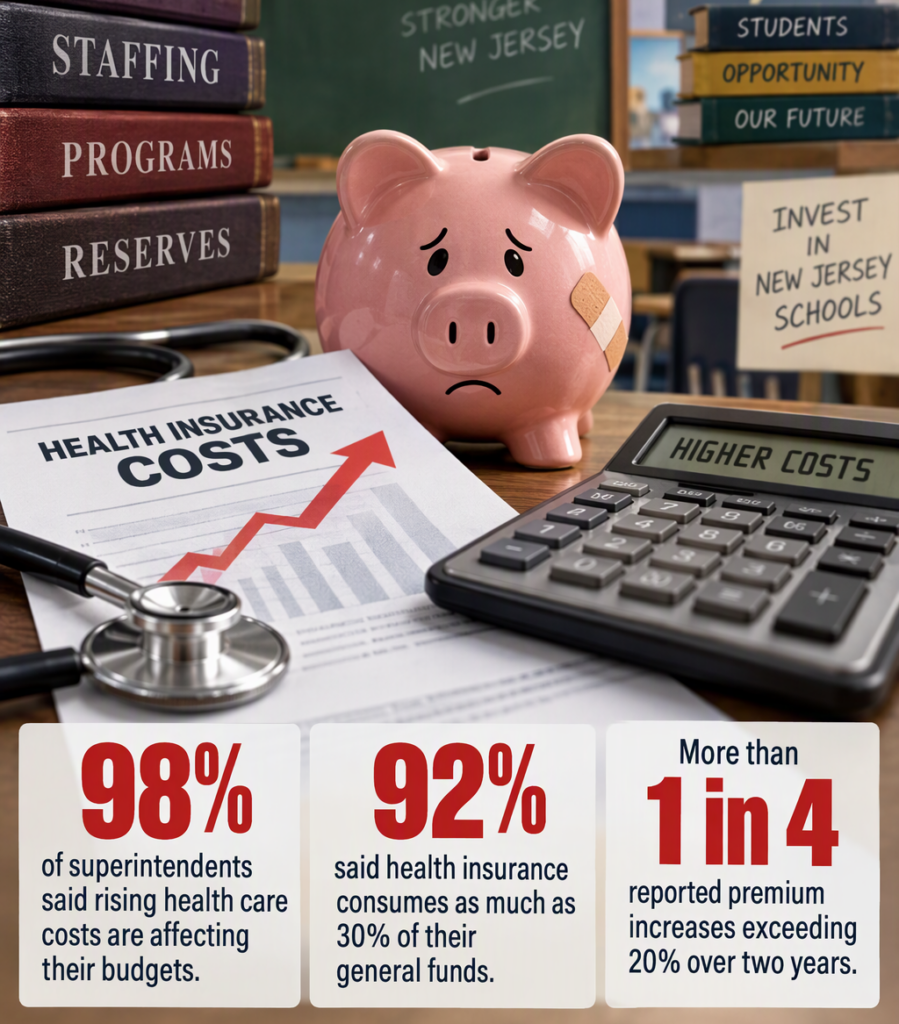
Image created by Microsoft Co Pilot.
EDITOR’S NOTE: This story was produced as part of the South Jersey Emerging Journalists Project (SJEJP), an independent initiative dedicated to supporting content creators and emerging journalists from underserved communities across Burlington, Camden, Gloucester, Salem, Cumberland, and Atlantic counties.
BY ASIYA ROBINSON | South Jersey Emerging Journalists Project
A national survey by The School Superintendents Association (AASA) and the Association of School Business Officials found 98% of superintendents who responded felt rising health care costs were affecting their budgets.
HADDON TOWNSHIP — New Jersey school districts facing steep increases in employee health insurance costs are drawing down reserves, reconsidering staffing and programs, and asking taxpayers for more — pressures that local officials and state lawmakers say are exposing gaps in the state’s education funding system.
Ninety-two percent said employee health insurance consumed as much as 30% of their general funds, while more than one-quarter reported premium increases exceeding 20% during the course of two years.
Districts reported using reserves, cutting instructional materials and technology spending, delaying hires and reducing family coverage options to absorb the increases. In Haddon Township, the school district initially projected a 25% overall increase in health care costs for 2026-27 before the final figure came in at 18%.
The district also reduced a projected 30% increase in prescription costs to about 8% by changing plans through its broker while keeping benefits the same.
The relief was relative, said Kellie Hinkle, president of the Haddon Township Board of Education and founder of the New Jersey Fair Funding Collective. The collective is a group of educators, school board members, parents, and community members committed to making New Jersey’s public school funding system more predictable, equitable, and stable.
“We felt so relieved at 18%, which is still a big number,” Hinkle recalled.
Costs exceed districts’ room to maneuver
Health insurance expenses are not directly incorporated into New Jersey’s school funding formula, an issue the Fair Funding Collective wants the state to address as it reviews school aid.
“One of our recommendations is about healthcare because while it’s not directly tied to the formula itself, it really deserves its own category because the costs are astronomical and they’re really consuming a lot of districts’ budget capacity,” Hinkle said.
The collective is developing recommendations for the state Department of Education and the state Legislature. Their proposals will include measures to limit payments for high-cost hospital procedures in New Jersey’s school employee health plans, aligning these payments with Medicare rates.
They also plan to address issues with prescription drug middlemen driving up prices, reform the governance of the New Jersey School Employees’ Health Benefits Program, and revise Chapter 44 — the state law governing school benefits — to ensure payers have a seat at the negotiating table.
They also aim to incorporate a healthcare cost-growth factor into the cost assumptions of the formula and emphasize that the issue should not be resolved by shifting costs onto districts, which could lead to reduced benefits or increased financial burdens on employees.
One proposal, the Property Tax Relief Act (S-4282/A-5086), would cap certain hospital payments at 165% of a reference price for in-network services and 150% for out-of-network services. Hinkle pointed to Oregon, where comparable measures were estimated to save about $107.5 million during their first 27 months. New Jersey’s proposed limits would be stricter, she said. The act was proposed by Sen. Joseph Vitale, a democrat from Woodbridge, in May.
The group also supports changes to prescription drug pricing practices, including more transparent pricing, fair dispensing fees, and restrictions on practices that can increase costs. The issue has become more prominent as prescription spending rises, including spending on GLP-1 weight-loss medications.
The Haddon Heights Board of Education cited GLP-1 drug costs among the factors contributing to a roughly $2 million budget gap this year. The district adopted a 6.93% tax increase, cut 10 positions and increased student fees.
Collingswood Business Administrator Beth Ann Coleman said the expected expiration of Chapter 44, the 2020 law that bases employees’ health-benefit contributions on salary, adds urgency.
“While Chapter 44 changed contribution structures, it failed to curb the underlying cost of healthcare,” Coleman said. “With Chapter 44 set to expire in December 2027, Trenton must step up with real systemic reform, cost-containment measures, and plan-design flexibility before escalating insurance costs force deeper cuts into New Jersey classrooms.”
Under Chapter 44, school districts pay the remaining cost of health-benefit contributions outside of school employees’ shares. The law also applies to districts outside the State Employee Health Benefits Program when they select comparable plans.
State benefits program faces deficits
School districts face significant pressures, according to state Assemblyman Lou Greenwald, a democrat from Voorhees.
“The School Employees’ Health Benefits Program is in real trouble,” Greenwald told The Retrospect. “As districts with healthier employee populations leave for cheaper coverage, the districts that remain are forced to pay more.”
Greenwald said legislation included in this year’s budget transferred money into the program to keep claims paid and avoid an immediate midyear premium increase. The budget also directs the State Employee Health Benefits Plan Design Committee to identify $75 million in savings.
As of last Dec. 31, the program’s reserve fund designed to buffer against unpredictable claims was facing a deficit of $66 million. State projections indicated a planned transfer of $70 million in 2026. Aon, the state’s benefits consultant, recommended a significant increase in local education premiums for 2027: a 34.4% rise in overall active premiums, which includes a 32.4% increase in medical premiums and a 45.5% increase in prescription coverage.
The State Department of Education said it recognizes the pressure that benefit costs are putting on districts. The department is examining the issue as part of a broader review of how school funding is distributed, spokesman Mike Yaple said.
The state’s Fiscal Year 2027 budget includes $12.4 billion in K-12 aid and limits on year-to-year aid changes intended to give districts more stability as funding shifts, state officials said. But Yaple said substantial revisions to the formula would require legislation and coordination between the administration, Legislature and stakeholders.
Gov. Mikie Sherrill has directed the department to engage educators, families, community leaders, lawmakers and others in the funding-formula review. The Fair Funding Collective plans to submit recommendations, though Hinkle said durable changes could take years and might not bring relief before the 2028-29 school year.
Republican state Sen. Latham Tiver, from Southampton Township, criticized the state’s aid-increase cap.
“New Jersey’s school funding formula is broken, and the arbitrary cap on aid increases is only making it worse,” he told The Retrospect. “For years, Trenton Democrats told districts they had to follow the formula no matter how painful the cuts were. Still, now that the formula calls for some of those same districts to receive more aid, suddenly following it is optional.”
U.S. Rep. Donald Norcross, a democrat who represents South Jersey, said the state should address the causes of escalating costs.
“The answer is to address the root causes of rising healthcare costs while ensuring schools don’t lose their already limited resources, and the billions of dollars in cuts to K-12 funding that President Trump and Republicans are pushing for will only suffocate local budgets further,” he said.
“The biggest thing we can do right now for school budgets is to kill those federal cuts.”
For school leaders, the immediate problem remains: Health costs are largely fixed in annual budgets, leaving fewer choices elsewhere.
“If nothing does change at the state level, we’d have to cut other things that are under our discretion, and that could mean student programming,” Hinkle said.
This story was produced as part of the South Jersey Emerging Journalists Project, with funding support from the People’s Media Fund and the New Jersey Civic Information Consortium.
Follow Us Today On: