NJ’s New E-Bike Law Leaves Some Families and Businesses Adjusting to New Reality
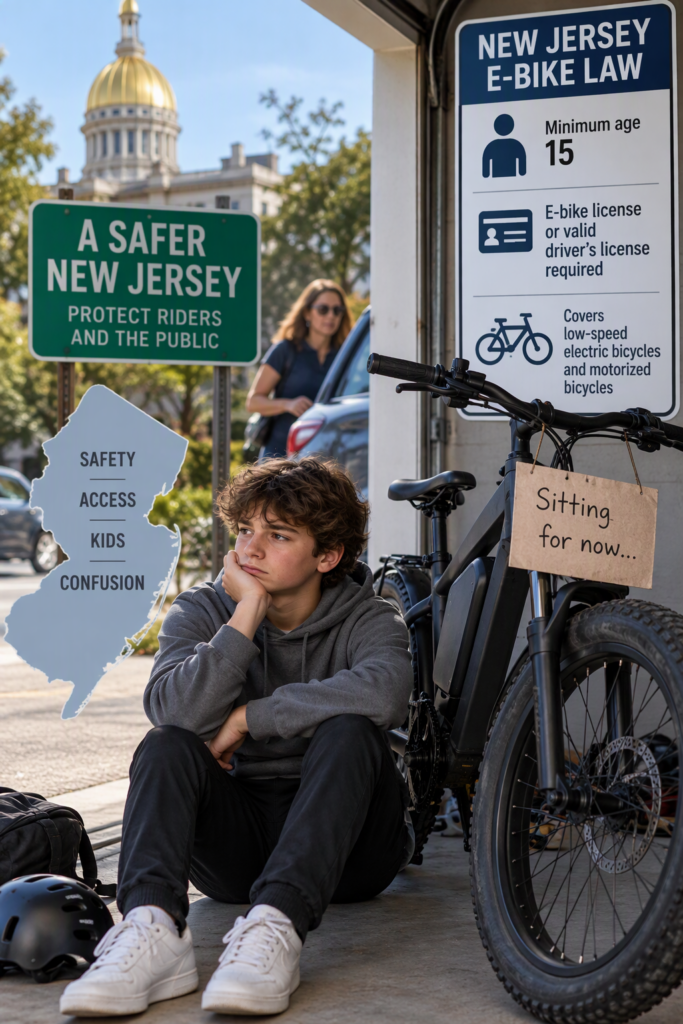
Image created by Microsoft Co Pilot.
EDITOR’S NOTE: This story was produced as part of the South Jersey Emerging Journalists Project (SJEJP), an independent initiative dedicated to supporting content creators and emerging journalists from underserved communities across Burlington, Camden, Gloucester, Salem, Cumberland, and Atlantic counties.
BY AHNYAH PINCKNEY | South Jersey Emerging Journalists Project
WILLIAMSTOWN — Supporters of a new law in New Jersey imposing stricter rules around e-bikes say it will protect riders and the public, while parents and bike shop owners argue the measure has created unintended consequences — from limiting transportation for teens to creating confusion over which electric vehicles are actually covered.
In January, New Jersey created a new law to created to improve safety in the state to lessen the number of accidents involving electric two-wheeled vehicles.
Parent Jennifer Lozano says that her 13-year-old-son used his electric bike to visit his friends, but now, his e-bike sits in the family’s garage collecting dust because of the new regulations.
”If he didn’t have this e-bike and I’m working, I have to stop and bring him 15 minutes away,” said Lozano, 52, of Williamstown. “That’s a half hour of my time taking him somewhere.”
The law enacted July 19 stipulates that e-bike operators must be at least 15 and have either an e-bike license or a valid driver’s license, according to the New Jersey Motor Vehicle Commission.
The term “e-bike” commonly refers to both low-speed electric bicycles and motorized bicycles.
The New Jersey Motor Vehicle Commission defines a low-speed electric bicycle as one that provides motor assistance only when the rider is pedaling and can reach speeds up to 20 mph. A motorized bicycle includes electric bicycles that can travel between 21 and 28 mph while pedaling or use a throttle to reach speeds up to 28 mph.
Insurance requirements depend on the speed of which the individual bike is capable. Operators of motorized bicycles must have insurance while operators of low-speed electric bicycles are not required to have insurance.
The law was created to boost public safety and limit the rising number of accidents happening across the state.
A federal government study of e-bike accidents in 2023 found that the age group most commonly affected by e-bike injuries were those ages 10 to 13. They accounted for 44.3% of respondents.
The study also found that in cases in which helmet use was recorded, 97.3% of e-bike riders injured in accidents were not wearing a helmet, compared to 82.1% of pedal bicycle riders and 87.2% of moped riders.
The data may be alarming for some, but for others, like Lozano, e-bikes can be a convenient way for teens to travel independently if they ride with caution and care.
“The majority of kids that are using these now are between the ages of 12 and 16 … they can’t drive yet,” Lozano said. “Your friend could live 15 minutes away, so these kids go back and forth on these bikes. That’s how they get around.”
She also believes that e-bikes are perfect for those who live in rural areas and have to travel great distances to reach their destinations.
“This is such a big town,” she said. “It’s really the only way to get around.”
Some critics argue that the issue isn’t regulation itself, but how the law classifies different types of electric bikes.
Shannon Connor opened up her e-bike/e-trike shop, Jesse’s e-Rides, in Shrewsbury alongside her husband, Frank, because of the impact electric tricycles had on the life of her autistic son, Jesse.
“We got an electric tricycle for him, and it changed his life completely in one day,” Shannon Connor said. “We were able to ride with Jesse and go downtown to local events.”
Her goal was to be able to get even challenged people outside and mobile. She believes that the new law overlooks disabled people such as Jesse, who is 16.
“Thousands of disabled people across the state now have their only form of independence and transportation taken away,” Connor said.
Connor creates informational videos on social media breaking down the regulations of the law. She says that there are many misconceptions and the main is that all e-bikes are the same and/or bad.
Connor said it is important for people to understand the difference between low-speed e-bikes and higher-powered electric motorcycles and for parents to educate themselves and their children before purchasing an e-bike.
Reporting by NJ.com found that many of the fatal crashes in New Jersey involved electric motorcycles rather than low-speed e-bikes.
William Kurz, a patrol officer for the Hammonton Police Department, urges riders to be more aware of their surroundings and wear proper protective gear.
“Wear helmets because a lot of kids don’t wear helmets,” he said. “I would recommend knee pads and elbow pads too because that’ll s\ave you from messing up your knees and elbows.”
Police are not bothering riders unless they are blatantly endangering themselves or those around them, Kurz said.
“I’m not really looking to mess with people on e-bikes unless they’re doing something really stupid or don’t have a helmet on,” he said.
The new law has created more confusion than Kurz anticipated, he said.
Lozano said she recognizes the need for safety, but wishes the law was different.
“I agree with the fact that some things need to be in place, such as a helmet ordinance,” she said.
“I don’t agree with the age.”
This story was produced as part of the South Jersey Emerging Journalists Project, with funding support from the People’s Media Fund and the New Jersey Civic Information Consortium.
Follow Us Today On: