Burlington County’s Freedom Walk Retraces Path From Slavery to Liberty
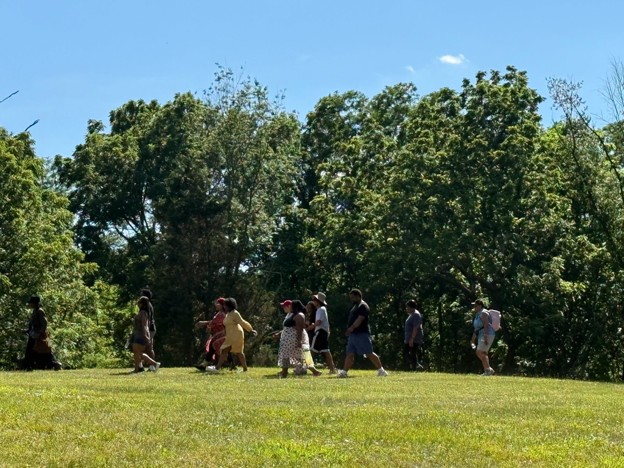
Participants follow the Freedom Trail’s Harriet Tubman toward Timbuctoo after completing the 3.5 mile Freedom Walk in Westampton, New Jersey. | Credit: Burlington County Prosecutor’s Office.
EDITOR’S NOTE: This story was produced as part of the South Jersey Emerging Journalists Project (SJEJP), an independent initiative dedicated to supporting content creators and emerging journalists from underserved communities across Burlington, Camden, Gloucester, Salem, Cumberland, and Atlantic counties.
BY MILAN PARKER | South Jersey Emerging Journalists Project
WESTAMPTON — It was no coincidence that 30 strangers gathered at the edge of Rancocas State Park to walk a path never meant to be easy. Pen and paper in hand, I stood among them in the woods of Westampton, about to retrace the 3.5-mile route from Westampton to Timbuctoo, one of the country’s oldest free Black communities.
I had been told this journey would be heavy, but no amount of research prepared my body for it.
Hosted by the Underground Railroad Museum of Burlington County, the Freedom Walk asked us to step away from the present and retrace the paths of those who once sought liberty in these very woods. The air was thick and green-smelling, and the only sounds were birdsong and the low murmur of the creek running to our right.
I expected a reflection of the past; instead, I walked straight into a story interwoven with the present and the fight for our future.
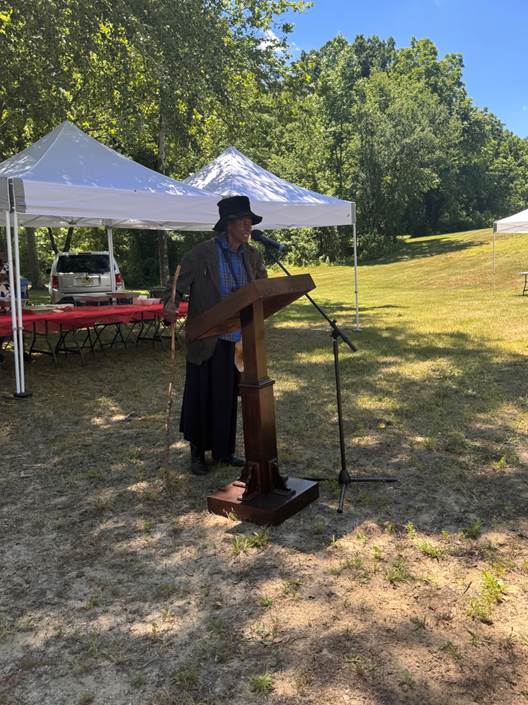
On a hilltop, our guide, Eric Orange, stood dressed as a Quaker, reenacting for one afternoon the part of those who once helped guide enslaved people to freedom. He offered a warning that doubled as a thesis: “We can never approach what it must have been like to run for your life.
To know that you have to trust someone, but you can’t trust anybody. Every move is a life and death decision.” He paused. “There’s going to be a lot of bugs and heat today, but if you stay with us, you’ll get to Timbuctoo.”
Turning back might have seemed easier. Sweat gathered at my neck before we had gone a quarter mile, and for a moment, I felt 16 years old again, sweating through a mile in gym class on an arid Palm Springs summer day. Mosquitoes swarmed, hungry for more than just blood, and the heat sat heavy on our skin with no clean water in sight. Still, we kept walking.
Strangers cleared branches from the path for each other without being asked. Somewhere along the creek, I caught a man’s voice drifting through the trees talking about his wife, a therapist. Nearby, a woman mentioned her own work with underserved communities. Small, maybe, to anyone watching from outside, but on a trail built on trusting someone you had just met, no conversation felt unimportant.
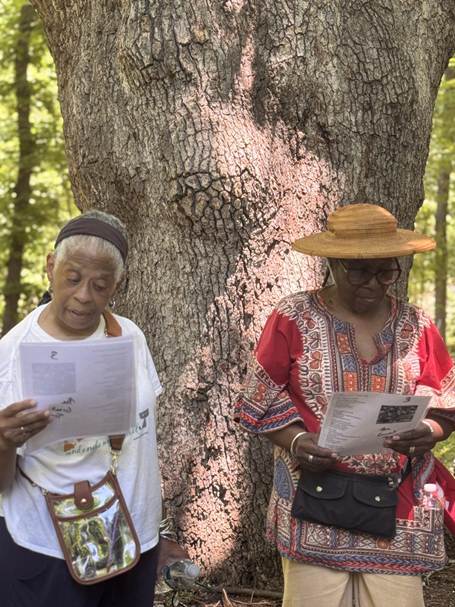
Just a few minutes earlier, we were a group of strangers reading Maya Angelou’s “When Great Trees Fall” aloud, stanzas flowing from person to person. Our facilitator had gathered us.
“As we do this walk,” he said, “we can not only hear the story and the history, but bring ourselves to that place. And there’s nothing that does that better than poetry.” He asked for volunteers, and hands went up immediately, sheets of paper moving down the line. I was quietly taken aback by how many people were willing. Public speaking among strangers is its own kind of nerve-wracking. And yet here we were, offering our vulnerability to each other freely, in a way we had not even thought about, the same way we had with Eric as our guide. Standing there, it was easy to understand: once you had started, there was no choice but to rely on your neighbor, in hopes of reaching our version of freedom, and of Timbuctoo.
Eric stopped the group near a heavily wooded area. Trails ran in every direction out here, he told us, with people coming from all sides, forcing split-second decisions where a wrong guess could cost you your life. He pointed to a spot a few yards off the path, a trench barely visible where slave catchers once hid.
Most of them were Southerners from below the Mason-Dixon Line, or Northerners chasing reward money with no real stake in the cause. They did not need to be seen to be dangerous. They only needed to wait.
There was something different in Eric’s manner as he said it, still chipper, still easy with the crowd, but with the air of a man holding something back. Rumors began to ripple through the group, low and half-joking: maybe he would stage something, maybe somebody was coming for us. Our chatter grew, easy and unbothered, until, with just a quiet gesture asking us to turn left and follow his gaze, Eric was not there anymore.
All we were left with was thirty people standing in the woods, looking around for the face that, a second ago, had been our guiding light to Timbuctoo.
A moment passed before Eric rose out of the ground about 20 feet away, a bunker dug into the earth, no more visible than the trail markers we had stopped noticing an hour in. Out here, you could be standing inches from danger and never know it.
Eric stepped forward. “You never know where people are coming from,” he said. “If someone told you to take the tunnel to freedom, this is exactly what you would envision.” He asked us to follow him through it. None of this, he added, would have been possible without local people willing to help, willing to go out on a limb. “There are plenty of them,” he said. “We actually have a family willing to do that, even now.”
We followed him, still uneasy from watching him disappear and resurface out of the ground only minutes before. Trust, again, with no real choice attached to it; just our guide, leading us toward Timbuctoo. He told us about the Sloan family, the private residence at the end of the trail. The walk crosses their property to reach Timbuctoo, and every time the museum asks, he said, the family is glad to let freedom seekers through.
In the 1800s, a house like this was a gamble, a roll of the dice where the wrong person could end your life. You never knew if the people inside were allies or if they were waiting to turn you in. You had to trust that the person behind the gate wouldn’t kidnap you, wouldn’t snitch, and wouldn’t betray your life for a reward. Walking through the Sloan family’s pathway, the weight of centuries old uncertainty turned my knees into concrete. The Sloans were not risking their lives as people once did, but they were a reminder that the village is still here if we choose to open our own gates.
We kept walking, and walking, and walking, surrounded by nothing but trees, friendly houses and our own intuition, guiding us toward what finally felt like sanctuary.
I felt the call of the spirits who had walked these same trees before us, the “Spirit Trees,” as Eric called them. I felt them rising in goosebumps across my skin, and then, all at once, it broke. Two hundred years of distance collapsed into one single afternoon. My body finally caught up to my mind, walking alongside everyone who had made this same walk before me, arriving at Timbuctoo to the sound of “Summer Madness” by Kool & the Gang.
Milan Parker is a contributing writer at Front Runner New Jersey as part of the South Jersey Emerging Journalist Project. In her spare time, she enjoys listening to music, shopping for vintage clothing, documenting her life through polaroid photography, and inline skating. She can be reached at milan.parker.sjejp@gmail.com.
A reenactor in the likeness of Harriet Tubman greeted us there. She told us that simply arriving, that our willingness to be vulnerable and to trust each other, had paid off.
How many stories have been lost over the years — dreamers who took this same path that we may never know about? Looking back towards the hilltop, I thought of what Eric said: names and dates are carved in granite, but even granite fades. Plant a tree, however, and you are good for five hundred years or more. The trees that surrounded us throughout our journey stood silent for the strong and the determined, and yet they are still here, bearing witness to a history that refuses to disappear. Trusting others, and having that trust challenged, is only a fraction of what happened on the Underground Railroad in New Jersey. But for this, I am forever grateful: to experience even a fraction of what my ancestors, and the spirits of those who came before us experienced for the price of freedom in America.
Follow Us Today On: